If you’ve ever wondered how does virtual reality work, you’re in good company. VR looks like magic from the outside: someone puts on a headset, suddenly ducks behind a virtual crate, and laughs at something you can’t see. Underneath, though, it’s a handful of clever ideas working together. Here’s a plain-English tour, from what’s inside the headset to how free-roam VR lets a whole group walk around a virtual world together.
What Is Virtual Reality?
Virtual reality is a computer-generated environment that surrounds you and responds to your movements. Instead of looking at a flat screen, you wear a headset that fills your field of view with a 3D world. Turn your head and the world turns with you. Lean in and things get closer. Your brain, which is very good at believing what your eyes and ears tell it, accepts the scene as a place you’re actually in.
That feeling is often called presence, and it’s the whole point of VR. Everything in the technology exists to create and protect it.
The Four Ingredients of VR
Most modern VR comes down to four things working together.
1. Displays and lenses
Inside a headset are screens positioned close to your eyes, with special lenses that bend the image so it fills your vision. Each eye sees a slightly different view, just like in real life. Your brain combines the two into depth, which is why a virtual cliff edge can make your stomach flip even though you know you’re standing on solid ground.
2. Tracking
For the world to react to you, the system needs to know where your head and hands are. Headsets use sensors and cameras to track your position and rotation, and controllers are tracked too, so your hands appear in the virtual world. This is what makes reaching, grabbing, and ducking feel natural instead of like pressing buttons.
3. A fast computer (or a fast headset)
The world has to be redrawn many times every second in response to your movement. If the picture lags behind your head, the illusion breaks, and some people feel uncomfortable. That’s why VR needs serious processing power, either in a standalone headset or in a computer.
4. Spatial audio
Sound is half the experience. In VR, audio comes from specific directions, so you can hear a footstep behind you or a voice off to your left. Good sound design sells the world as much as the graphics do.
Seated, Room-Scale, and Free-Roam VR
Not all VR is the same. The big difference is how much you can move.
- Seated or standing VR: You stay in one spot, usually with a small play area. Great for casual games and at-home play.
- Room-scale VR: You can walk around within a defined space, often a few steps in each direction.
- Free-roam VR: You walk through a much larger open arena, and your real steps become your steps in the game. Because the space is big, you can explore a whole virtual world on foot, and multiple players can share it at once.
Free-roam is the version that feels most like stepping into a movie. If you want the longer explanation, our guide on what free-roam VR is goes deeper.
How Free-Roam VR Works for Groups
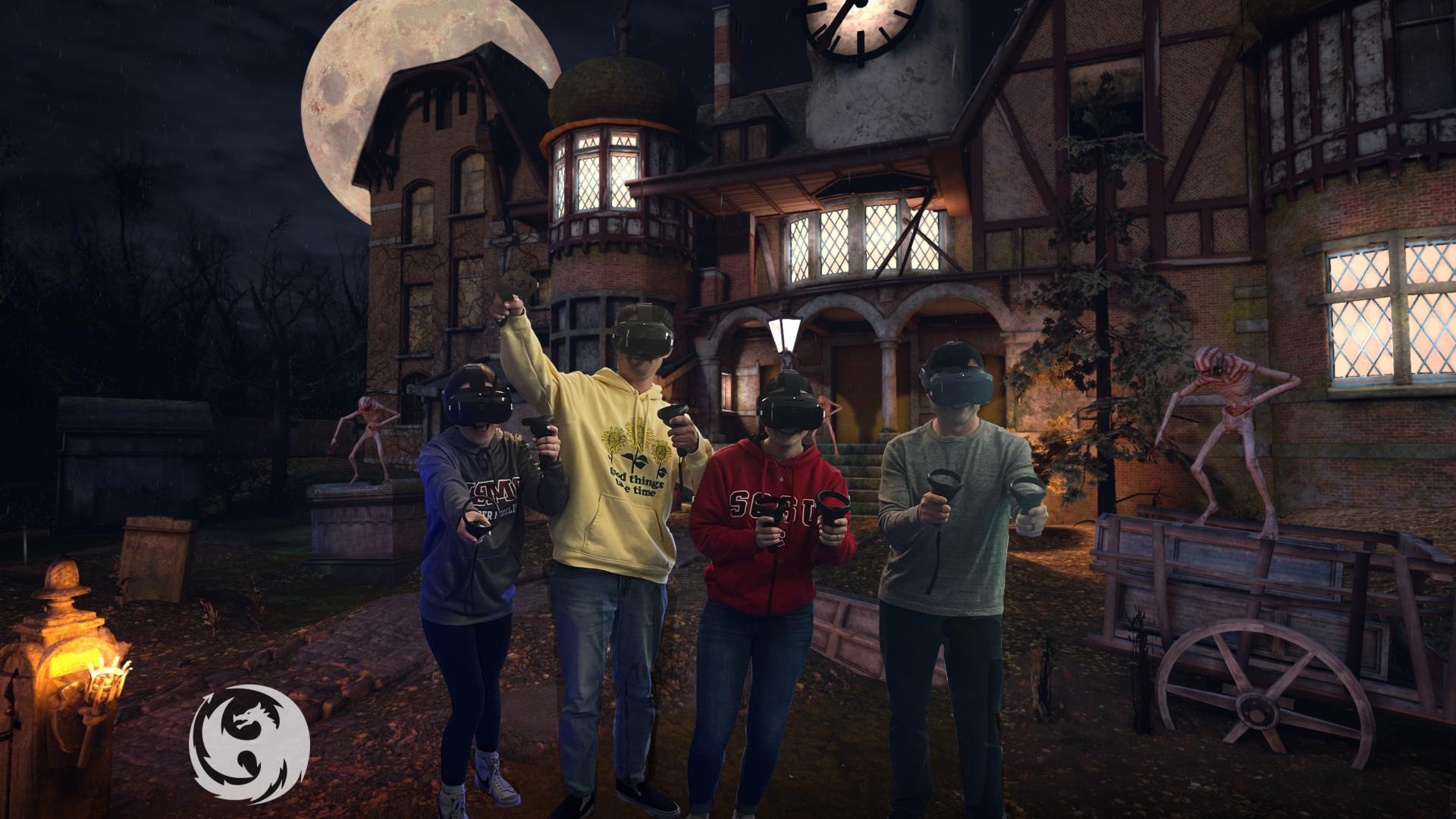
Here’s where it gets fun. In a free-roam arena, everyone in your group wears a headset and moves through the same physical space. The system tracks each person and shows them as avatars to each other inside the game. When your friend walks to the virtual door, you see them walking to the virtual door.
Because you’re sharing a real space, the experience is social. You can high-five, point, shout “behind you!” and actually be heard. The arena is designed to keep players safe and in bounds, and staff are on hand to set you up and help throughout.
At Escape To VR in Carlsbad, that means groups can try team-based VR escape games where everyone has to communicate and solve puzzles, or drop into the walk-in VR arcade for lighter, faster-paced play.
Why VR Can Feel So Real
A few tricks make VR convincing:
- Wide field of view fills your peripheral vision, so you don’t feel like you’re looking through a window.
- Low latency means the world reacts almost instantly to your head movement.
- Hand presence lets you use your own hands rather than a controller abstraction, which makes interaction instinctive.
- Your own body knows what to do. You duck, lean, and step aside without thinking.
Your brain knows it’s a game, but your body often responds anyway. That’s why first-timers tend to flinch, laugh, and say “wow” within the first minute.
Is VR Comfortable for Beginners?
Most people settle in quickly, especially when the experience is well designed and someone helps you get fitted. Some people are more sensitive than others, and a few take a minute to adjust. If you’re curious about what the first session feels like, read our first-time VR guide for tips on what to wear and how to ease in. If you or your child have specific health concerns, check with your doctor and ask our team questions on the FAQ page or contact page before you visit.
What You Actually Do When You Visit
A typical visit is simple: arrive, get a quick briefing, get fitted with your headset, and step into the arena. You don’t need any experience, and you don’t need to understand the technology. You just need to be willing to look around and play. That’s why VR works for kids’ parties, date nights, family outings, and team events alike.
Ready to see how VR works in real life? Book your Escape To VR session and find out for yourself. You’ll see current pricing and available times on the booking page. Planning for someone else? A gift card lets them pick the day.
The Short Version
VR works by combining close-up screens, motion tracking, powerful processing, and spatial audio to convince your brain you’re somewhere else. Free-roam VR takes that further by letting you and your friends walk through the same virtual world together. It’s easier to feel than to explain, so the best way to learn how it works is to try it.
Written by
VR Experience Director at Escape To VR. Carlsbad's premier free-roam VR arena — escape rooms, action games, and parties for up to 6 players.
Experience the adventure yourself.
Book a 60-minute free-roam VR session for up to 6 players.